
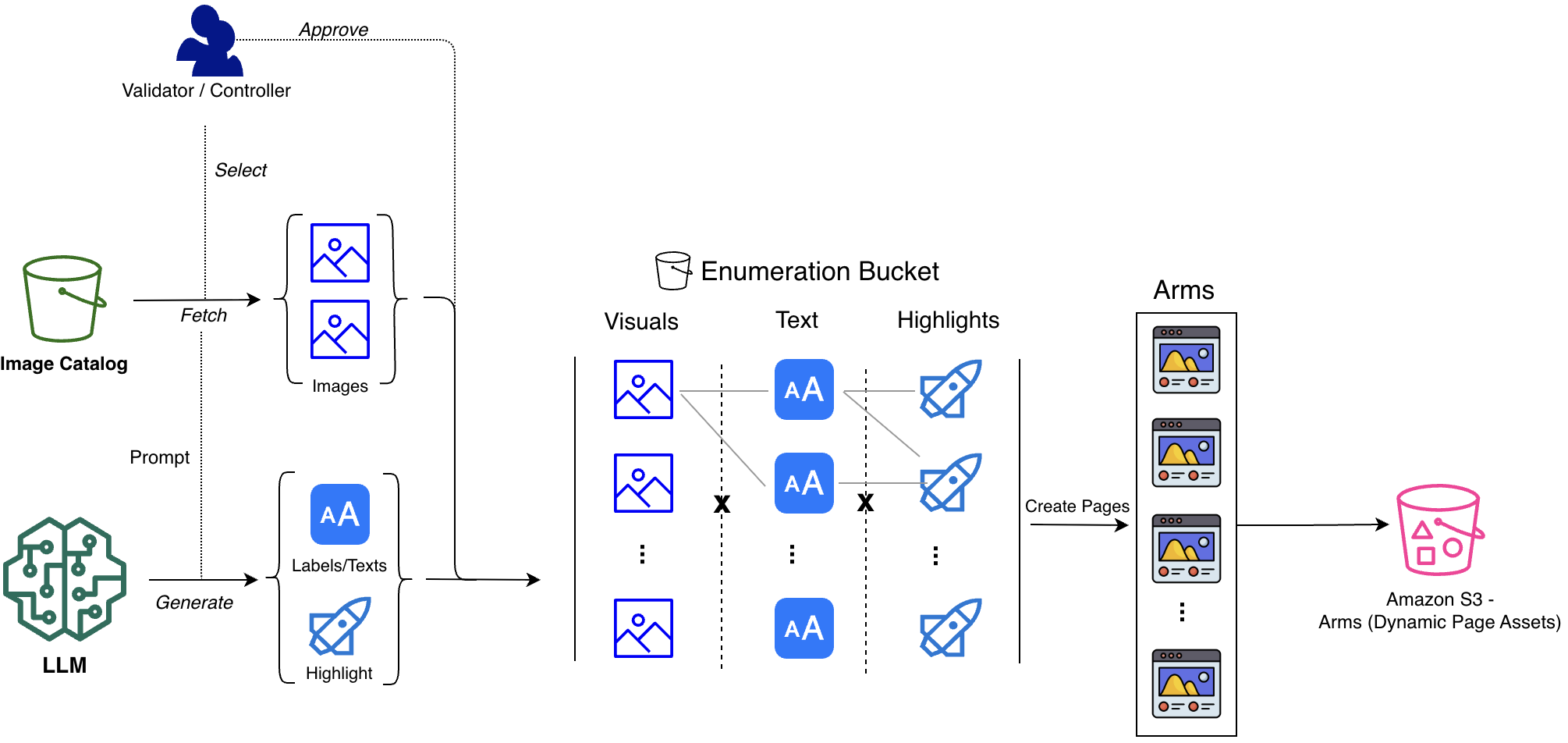
Generative AI has made it possible to produce large amounts of personalized content quickly and at low cost. In our previous post , we showed how generative AI on Amazon Bedrock can produce personalized content at scale while staying within brand guidelines and guardrails. The new challenge is now one of selection. Among all of those options, which one do you show each customer, and how long does it take to learn the answer? This post tackles the selection challenge that follows the proliferation. In this post, we share how Amazon Payments applied AI-based personalization to a product acquisition funnel, using a multi-objective contextual multi-armed bandit (MAB) on Amazon SageMaker AI . In a seven-week online A/B test we currently see a high single-digit percentage relative lift in final-funnel conversion for one customer population, while another saw no improvement over the existing experience. The problem turned out to be the content, not the model. We cover the intuition behind bandits, our extension to optimize an entire conversion funnel, and the AWS architecture behind the solution. We also share a code repository that you can use to test this approach on synthetic data and understand the method hands-on using Amazon SageMaker AI. Growing role of multi-armed bandits in the generative AI era A multi-armed bandit (MAB) is a reinforcement learning method built for settings with many options and limited traffic. It learns which option performs best while continuing to serve customers. It treats each content variation as an “arm,” tries each against live traffic, and stea
Source: AWS Artificial Intelligence