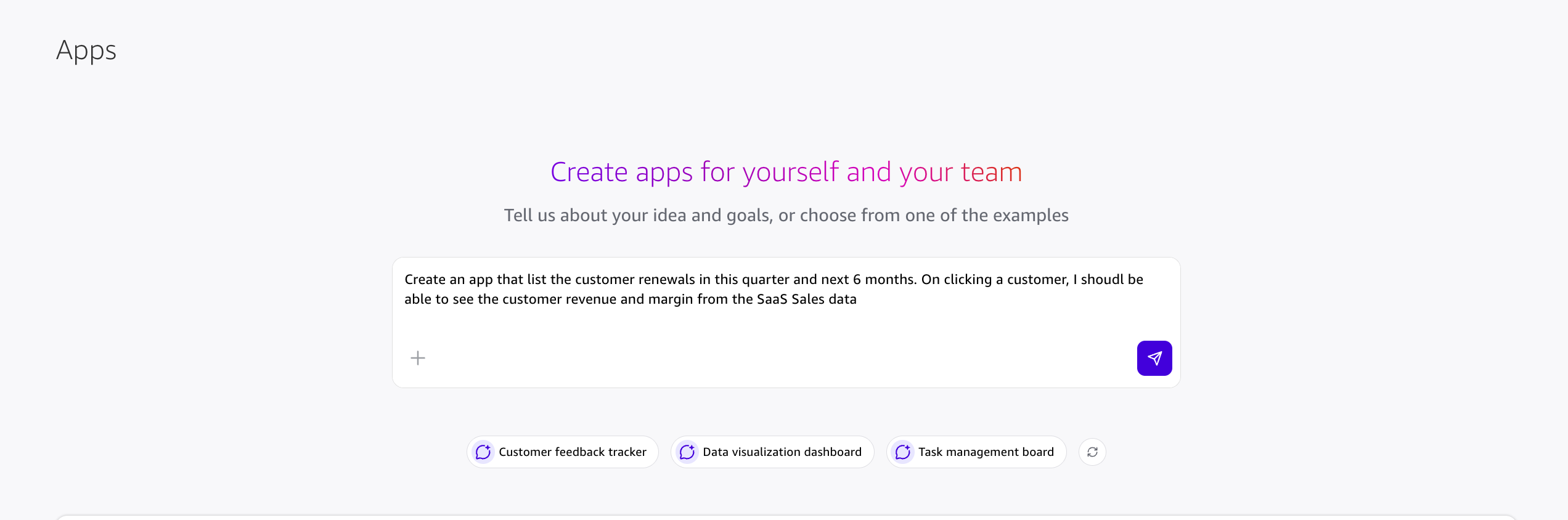
Quick Apps could already bring live data into an app from connectors and content sources: action connectors (services like Jira, Slack, and Google Drive), Spaces documents, web search, and AI inference all run at view time, not build time. The solution introduces live structured data from your data lakes, databases, and other analytics data stores. Your governed Amazon Quick Sight datasets, the SPICE and Direct Query tables that hold your business metrics, couldn’t be queried live from an app. Any dataset numbers an app showed were baked in when the agent built it. A snapshot frozen at publish time. That was fine for a static report, but it broke down the moment you wanted an app whose metrics reflected what your data says today, and that respected who is allowed to see which rows. Amazon Quick is an AI-powered unified intelligence service that connects all governed enterprise data and enterprise content, so teams can explore, analyze, and act from one place. With Quick Apps, you can describe an application in plain language and have an AI agent write and deploy a working web application, with no hands-on coding or DevOps steps required. In this post, we introduce Live Data in Apps , which AI-built Amazon Quick apps can use to query governed Quick Sight datasets in real time instead of relying on static, build-time snapshots. We walk through how to build, publish, and share a live-data app using natural language prompts, and cover key considerations, consent requirements, and query guardrails. What’s new: Live Data in Apps With Live Data in Apps , a published Quick app quer
Source: AWS Artificial Intelligence