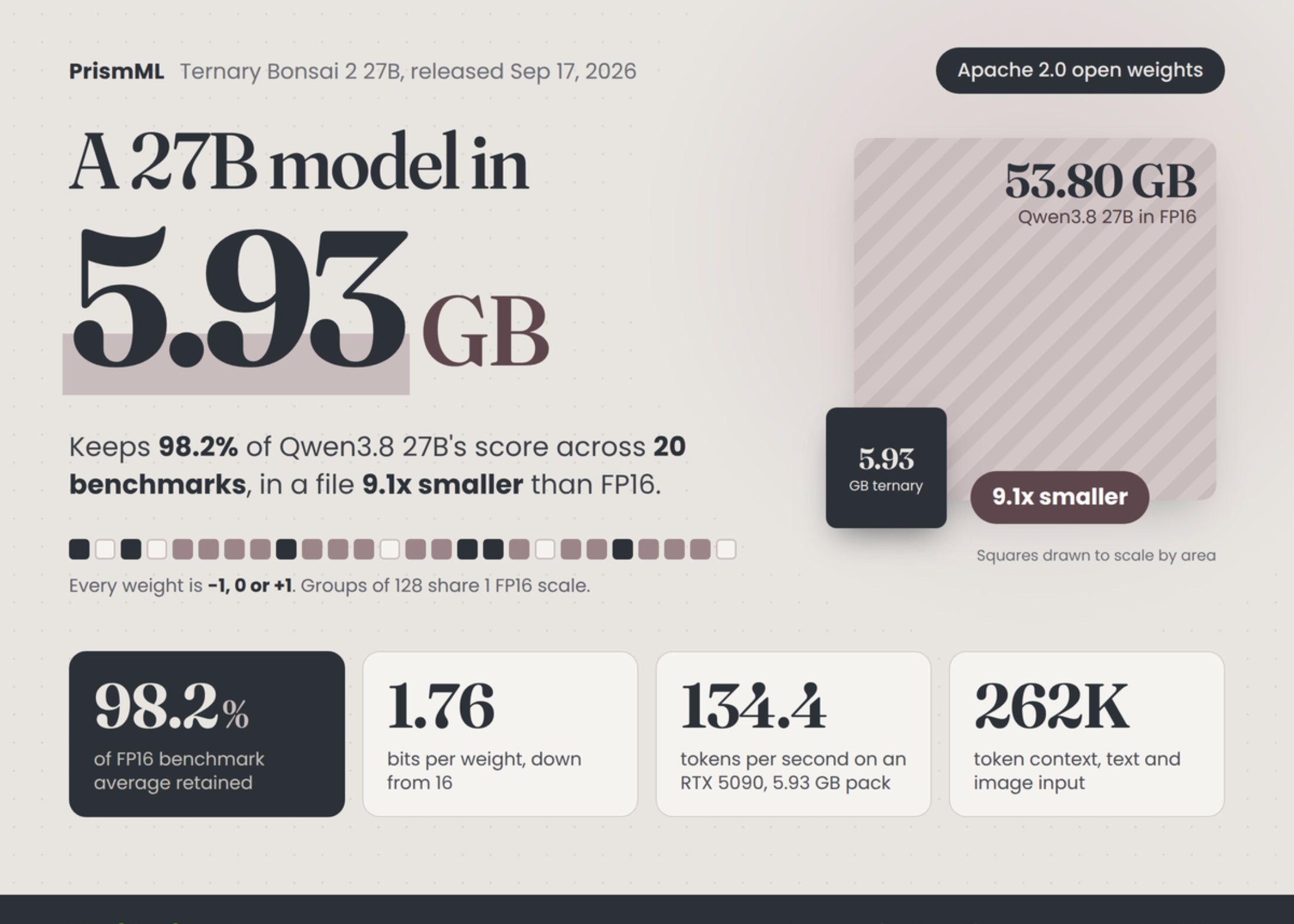
PrismML has released Ternary Bonsai 2 27B , a ternary-weight version of Qwen3.8 27B . The language model occupies 5.93 GB, against 53.80 GB in FP16. PrismML reports that it keeps 98.2% of the parent model’s average across 20 benchmarks. The model accepts text and images and supports a 262K-token context. PrismML demos it driving Cline coding agents and computer use on an RTX 5090. It arrives 2 months after the first Bonsai 27B , whose ternary variant retained about 95%. Is it deployable? Yes. The Apache 2.0 weights run today on a 16 GB laptop or a single 24 GB GPU. You need PrismML’s llama.cpp fork or its MLX runtime. What is Ternary Bonsai 2 27B? The model keeps the Qwen3.8 27B architecture unchanged. It has 27.36B parameters. That splits into a 24.35B language backbone, 2.54B in embeddings and LM head, and a 0.47B vision tower. The backbone uses hybrid attention, with about 75% linear-attention and 25% full-attention layers. Ternary weights cover embeddings, attention projections, MLP projections and the LM head. Only 26.2M parameters, or 0.0976%, stay in higher precision. Those are the recurrent state path and normalization weights. In GGUF, the vision tower ships separately as a 0.63 GB file, loaded only for image input. How Does the Ternary Format Work? Each weight takes 1 of 3 values: -1, 0 or +1. Every group of 128 weights shares 1 FP16 scale. A ternary value carries log2(3), or about 1.585 bits. Adding 16 scale bits per 128 weights gives 1.71 bits per weight. Counting the high-precision tensors brings the model to 1.72. Real kernels need a packed layout, so the whit
Source: MarkTechPost