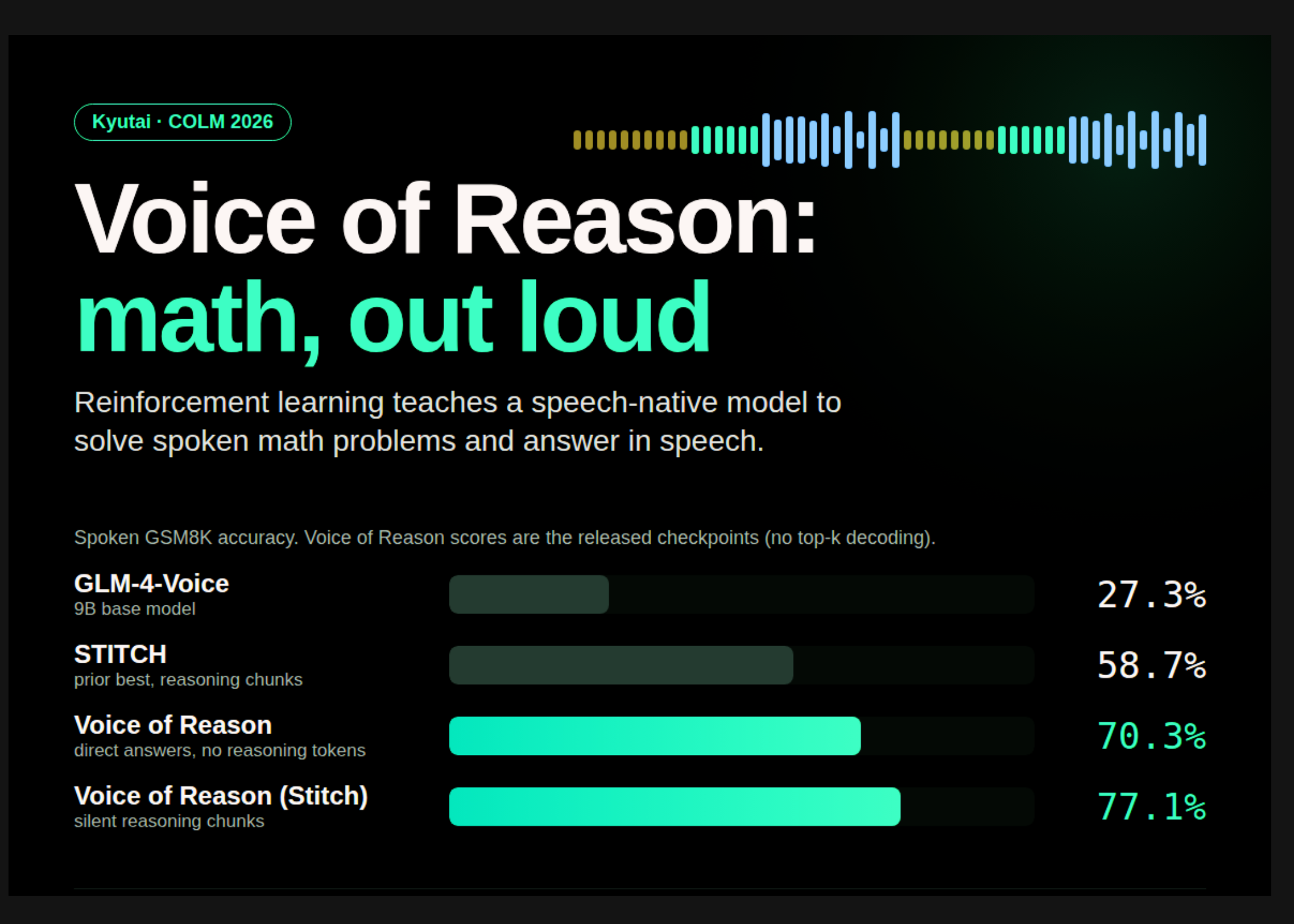
Kyutai has released Voice of Reason , 2 open-weight speech-to-speech models that solve math problems out loud. Both start from GLM-4-Voice-9B and add supervised fine-tuning (SFT) and reinforcement learning (RL). There is no transcription step and no separate text LLM in the loop. On spoken GSM8K, accuracy climbs from 27.3% for the base model to 77.1%. Is it deployable? Yes, for self-hosting. Kyutai ran both BF16 checkpoints on a single H100. You also need the GLM-4-Voice repo for its speech tokenizer and decoder. Weights inherit the GLM-4-Voice license, and no Hugging Face inference provider hosts them yet. Why Speech Models Lag on Math Cascaded pipelines (speech-to-text, text LLM, text-to-speech) still lead on reasoning. However, each stage adds latency, and the pipeline loses paralinguistic cues like tone. Speech-native models must emit audio at regular intervals to stay interactive. That limits how many hidden reasoning tokens they can afford. Base GLM-4-Voice scores 27.3% on GSM8K . The earlier STITCH method raised that to 58.7% by adding reasoning chunks. The research team call their work the first application of RL to math reasoning in speech-native models. How the Training Works GLM-4-Voice interleaves its output: 13 text tokens, then 26 audio tokens, repeating. Stage-1 SFT : Training uses 150,616 problems from Orca-Math . Qwen3-235B rewrote each problem for speech. Kyutai’s DSM TTS then voiced them in many voices. SFT alone lifts GLM-4-Voice from 27.3% to 61.7%. Stage-2 RL : For each spoken question, the model samples 4 replies at temperature 0.9. A judge, Qwen3-235
Source: MarkTechPost