
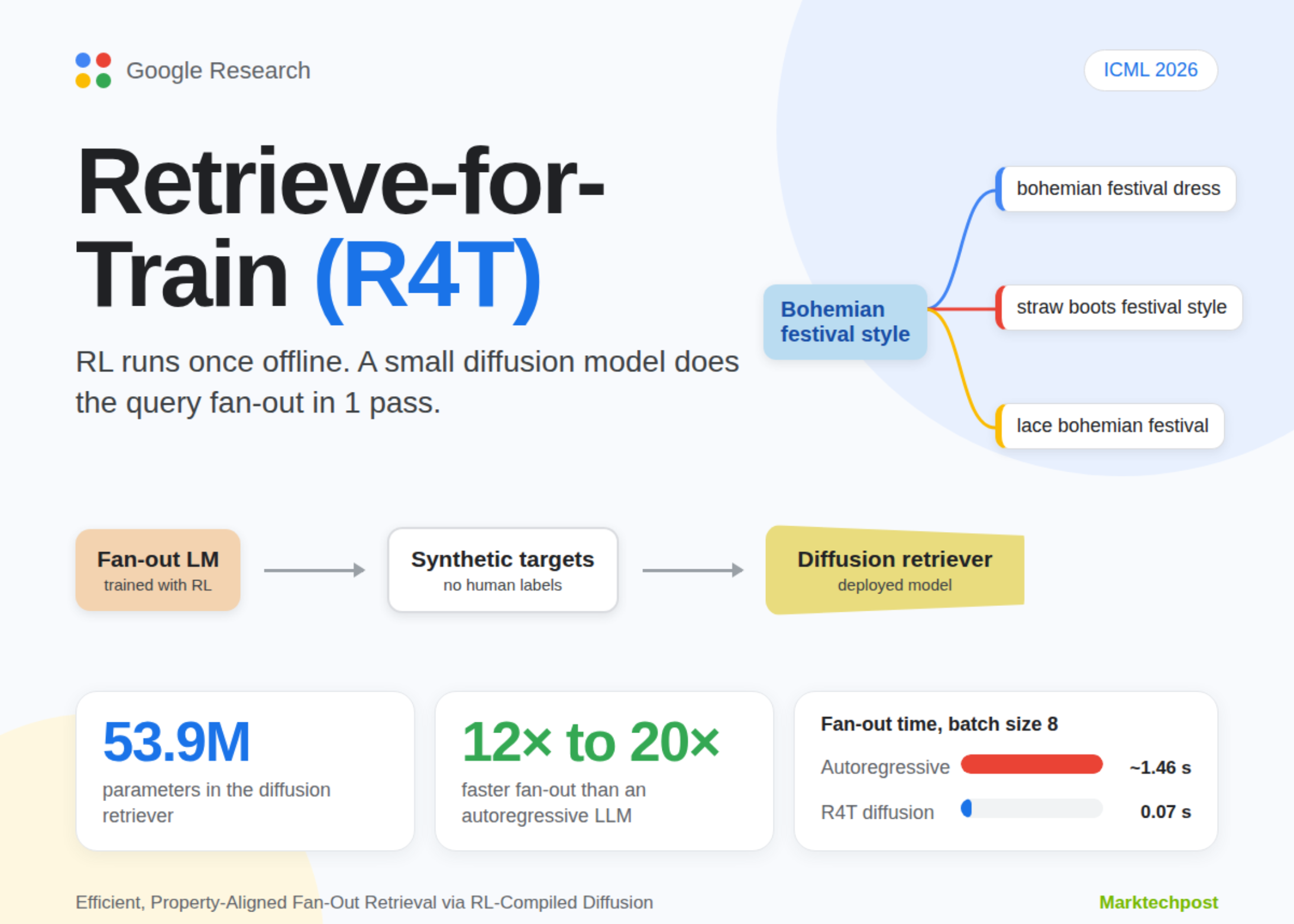
Search and recommendation systems increasingly need to return a set of results, not one best match. A query like ‘camping gear’ should return a tent, a sleeping bag, a stove, and a headlamp. It should not return 10 near-identical tents. Google Research has introduced Retrieve-for-Train (R4T) for this problem. The framework uses reinforcement learning (RL) once, offline, to learn good query fan-out. It then distills that behavior into a small diffusion model that produces all retrieval directions in 1 pass. Why Standard Fan-Out Falls Short Query fan-out splits one broad prompt into several sub-queries. The research team identifies 2 problems when a generic LLM does this at inference time. The first is paraphrastic collapse. For ‘Bohemian festival style,’ zero-shot Qwen3-4B wrote ‘bohemian festival fashion’ and ‘festival bohemian clothes.’ These near-synonyms retrieve a homogeneous slate. The second is latency. Autoregressive generation plus repeated retrieval calls is slow. Best-of-N sampling improves quality but multiplies inference cost. The 3-Step R4T Pipeline Fan-out LM training : A fan-out language model (FOLM) generates k sub-queries. A frozen dense retriever executes them. A set-level reward scores the whole retrieved set, not each item alone. Supervision synthesis : The trained FOLM samples 128 fan-outs per query at temperature 0.9. These become (query, target set) training pairs with no human labels. For open-ended tasks, targets are retrieved-content embeddings. For compositional tasks, targets are sub-query embeddings. Diffusive retriever training : A 53.9M-parame
Source: MarkTechPost