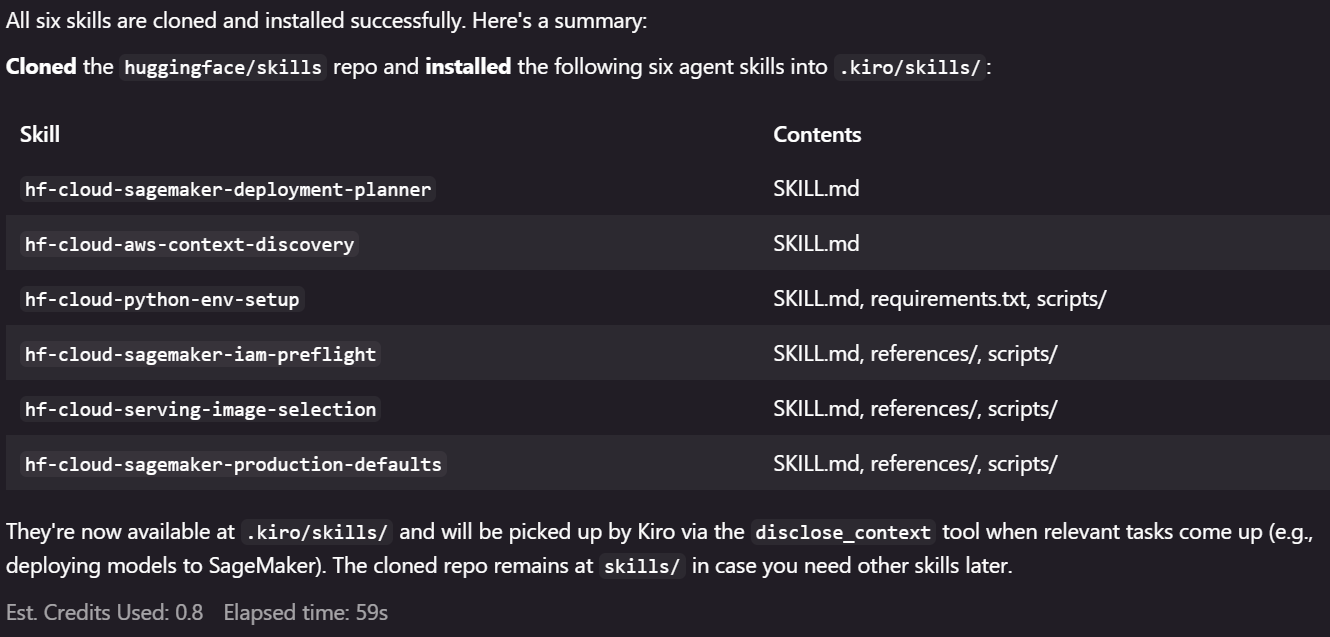
Deploying a Hugging Face model to production means making a dozen decisions: choosing the right serving container for the model’s architecture, confirming the current image tag for your AWS Region, and matching an instance type to the model’s memory footprint. Beyond infrastructure, you must wire autoscaling so you don’t burn GPU hours on an idle endpoint. You also set Amazon CloudWatch alarms that catch silent failures before your users do. After you’ve made those decisions, Amazon SageMaker AI collapses that work into hours. This kind of structured, repeatable work is exactly what coding agents, like Kiro and Claude Code , are built for. It’s tempting to describe a model to deploy in a coding agent, walk away, and come back to a working endpoint. In practice, an unguided coding agent might make wrong decisions, producing endpoints that are fragile, costly, or quietly wrong. The problem gets worse for newer models, since their training data might not include the latest deployment knowledge. In this post, you learn how to deploy production-ready Hugging Face models on SageMaker AI using agent skills. You install six skills from Hugging Face Skills , point a coding agent at a Hugging Face model, and get back a real-time endpoint with autoscaling, Amazon CloudWatch alarms, the correct serving container from the AWS Deep Learning Containers (DLC) catalog, and a verified teardown path. Real-time endpoint is the default, but the skills also support real-time with scale-to-zero, serverless inference, asynchronous inference, batch transform, and Amazon Bedrock Custom Model Import.
Source: AWS Artificial Intelligence