
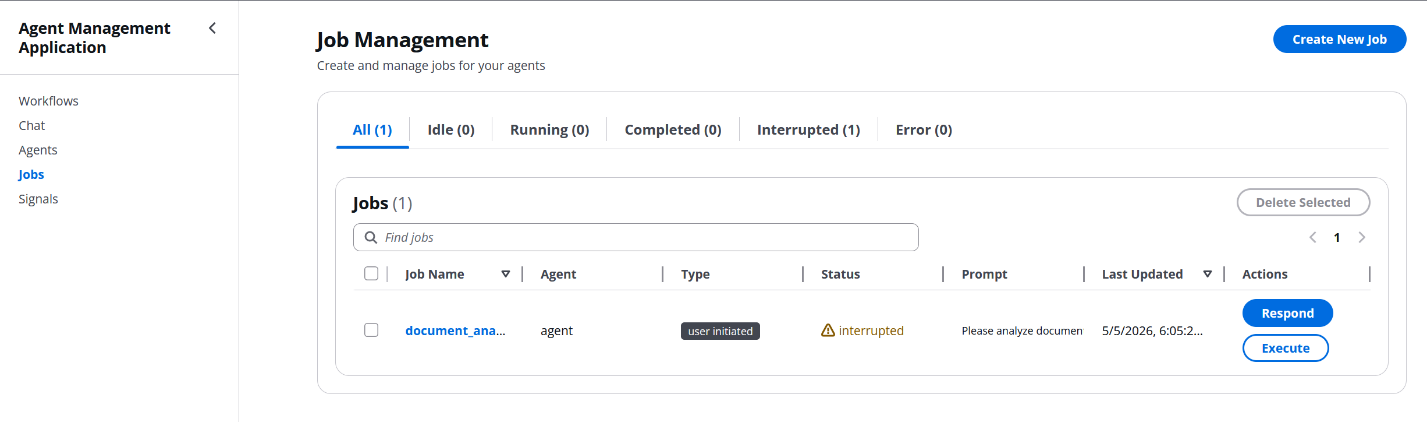
Teams that process documents at scale know the routine: files land in storage, someone notices, opens each one, decides what it needs, and routes it for review. Monitoring alerts queue up the same way, waiting for a person to act on them. The hours lost to manual triage are the operational problem ambient agents solve. Imagine a document lands in your Amazon Simple Storage Service (Amazon S3) bucket and within seconds a job appears on your Jobs page, ready to run (or already running if you configured it that way). The agent analyzes the file, surfaces the findings, and asks you for approval before taking the next step. The event itself is the prompt. That is an ambient agent: it responds to event streams, pauses for human input through a single ask_human tool when it needs to, and resumes from where it left off once the human answers. Figure 1: Overview of an ambient agent responding to an event on AgentCore Runtime and pausing for human input Most AI agent experiences today follow a different pattern: a user opens a chat interface, types a prompt, and waits for a response. That works for one-time questions, but it limits the agent to one conversation at a time and requires a human to describe what happened before anything can act on it. For scenarios where agents should react to events happening across your infrastructure (file uploads, database changes, scheduled tasks, system alerts), that chat-only model breaks down. Ambient agents describe a different paradigm, one that LangChain among others has articulated. Instead of waiting for users to initiate conversations, ambi
Source: AWS Artificial Intelligence