
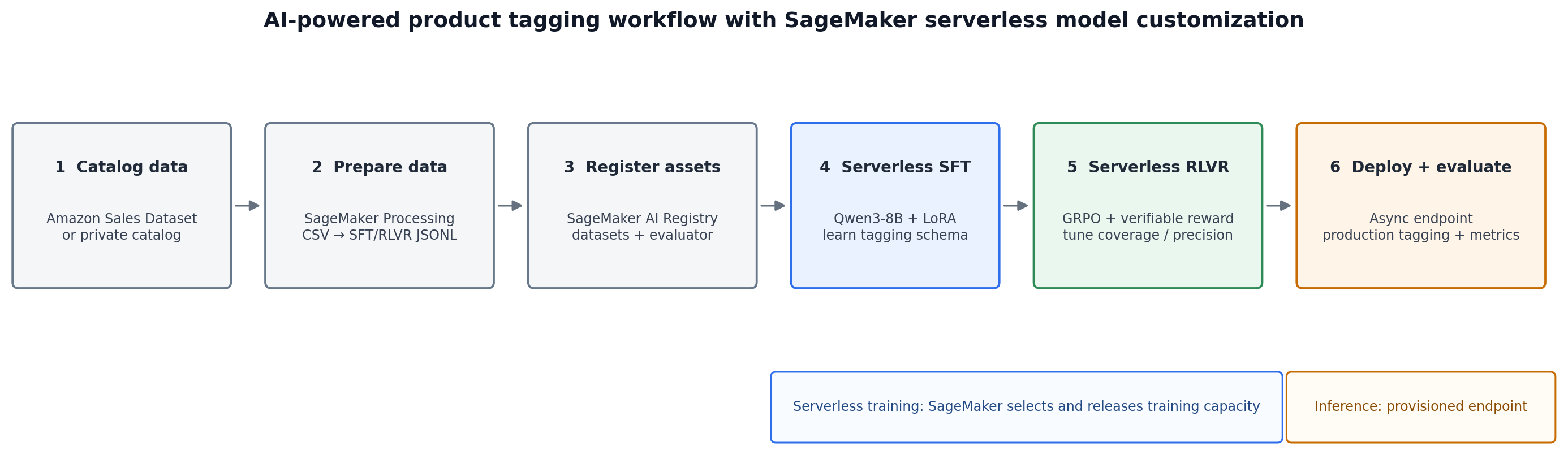
Retail catalogs rarely arrive as clean, structured attributes. Product names, descriptions, and category paths come from many sources and change continuously. Search, recommendations, and catalog navigation depend on consistent tags, but manually applying those tags across thousands of stock keeping units (SKUs) is slow and difficult to keep consistent. A general-purpose frontier model can generate tags with prompt engineering, but a high-volume tagging workflow usually has a narrower objective: return the right attributes in the right schema, consistently. When the taxonomy is stable and the output can be scored programmatically, customizing a smaller open-weight model can be a better fit for the task. With this approach, you can teach the model the schema directly and optimize the trade-off between missing tags and unnecessary tags. You avoid paying for broad capabilities that the workflow does not need on every request. In this walkthrough, we customize Qwen3-8B with supervised fine-tuning (SFT), then optimize it with reinforcement learning with verifiable rewards (RLVR) using Group Relative Policy Optimization (GRPO). Amazon SageMaker serverless model customization manages the training capacity, while the optimized model is deployed separately to Amazon SageMaker Asynchronous Inference for batch-oriented catalog enrichment. Read the SageMaker serverless model customization overview . Serverless versus Amazon SageMaker Training Jobs (SMTJ). The earlier Qwen3-8B example in the amazon-sagemaker-examples repository uses Amazon SageMaker Training Jobs with customer-selected
Source: AWS Artificial Intelligence